epraya.JMulpol#
- JMulpol(maham, Expe, Nucl1='None', Nucl2='None', M=70, graph=True, hifi=False, ktra=None)#
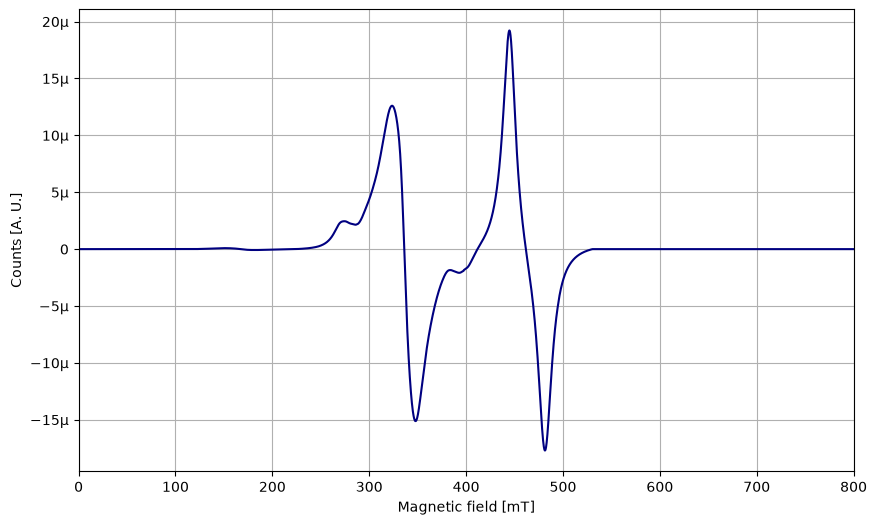
Wrap function for the simulation of the EPR spectrum for powder samples of two systems. If there is an interaction between the systems (electron-eletron or hiperfine), solves the total hamiltonian. Otherwise, sums the contributions to the total spectrum.
- Parameters:
maham (Class) – Container for the hamiltonian parameters of the two systems.
Expe (Class) – Container for the experimental conditions.
Nucl1 (str) – Isotope of the first system. Can be the quantum number and the element or only the element (‘55Mn’ or ‘Mn’)
Nucl2 (str) – Isotope of the second system. Can be the quantum number and the element or only the element (‘55Mn’ or ‘Mn’)
graph (Bool) – PLots the spectrum of the multisystem.
hifi (Bool) – Bool value to calculate the Jacobian matrix.
ktra (float) – Reference value of number of transitions.
- Returns:
Blist (jax.np.array) – Array of the magnetic field.
epc (jax.np.array) – Array of the counts of the spectrum.
Example
import matplotlib.pyplot as plt
import epraya as epr
import numpy as np
Ham,Exp,_=epr.Jmstart()
Ham.S1=3/2
Ham.I1=1
Ham.S2=1
Ham.I2=1
Ham.g1=np.array([2.003, 2, 2])
Ham.g2=np.array([1.5, 1.5, 1.5])
Ham.A1=np.array([200, 200, 200])  #Hyperfine constant
Ham.D1=np.array([800,200])      #Zero field D and E
Ham.Hpp=[0,10]
Exp.Freq=9.4
Exp.Points=4096
Exp.Temperature=300
Exp.Frange=[0,800]
B,spc=epr.JMulpol(Ham,Exp)