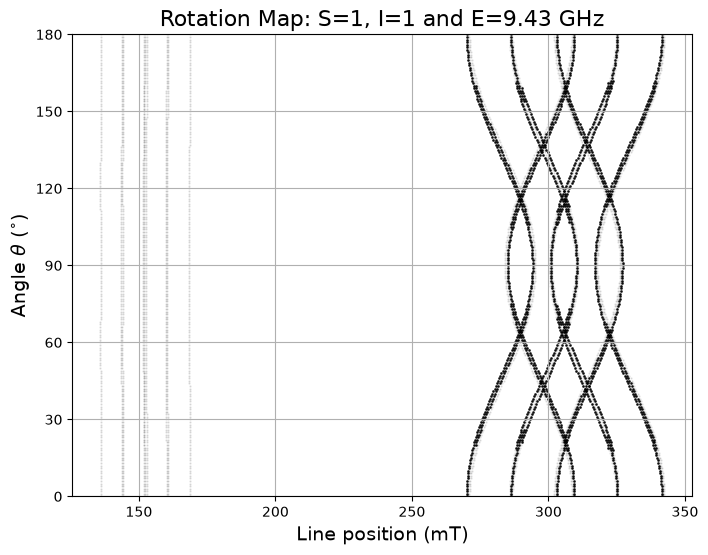
epraya.Nrotate#
- Nrotate(Hamer, Expe, phi=0)#
Shows the variation of the resonant fields in relation to the rotations of the sample by its z axis. Rotations are from 0 to 180 degrees and the inclination between the sample z axis and the lab z axis is defined by the user using the phi variable.
- Parameters:
Hamer (Class) – Container for the hamiltonian parameters of the system.
Expe (Class) – Container for the experimental conditions.
phi (float) – Angle of inclination between the sample z axis and the lab z axis.
- Returns:
anglex (np.array) – List of the angles where the spectrum was calculated.
fieldey (np.array) – Array of arrays of the resonant fields calculated for the different angles.
intens – Array of arrays of the spectrum intensity calculated for the different angles.
Example
>>> import epraya as epr¿
>>> Ham,Exp,Vary=epr.Start()
>>> Ham.S=1
>>> Ham.I=1
>>> Ham.Hpp=[10,15]
>>> Ham.g=[2.2,2.4,2.2]
>>> Ham.A=[500,250,500]
>>> Ham.D=[600,100]
>>> Exp.Points=4096
>>> Exp.Frange=[0,500]
>>> epr.Nrotate(Ham,Exp)
(array([  0.,   0.,   0., ..., 180., 180., 180.], shape=(4887,)),
array([309.49373398, 309.08035546, 308.63672174, ..., 303.06525967,
286.79959859, 271.07709288], shape=(4887,)),
array([5.53811424e-03, 0.00000000e+00, 2.66113213e-06, ...,
5.52709115e-03, 0.00000000e+00, 3.30914362e-06], shape=(4887,)))